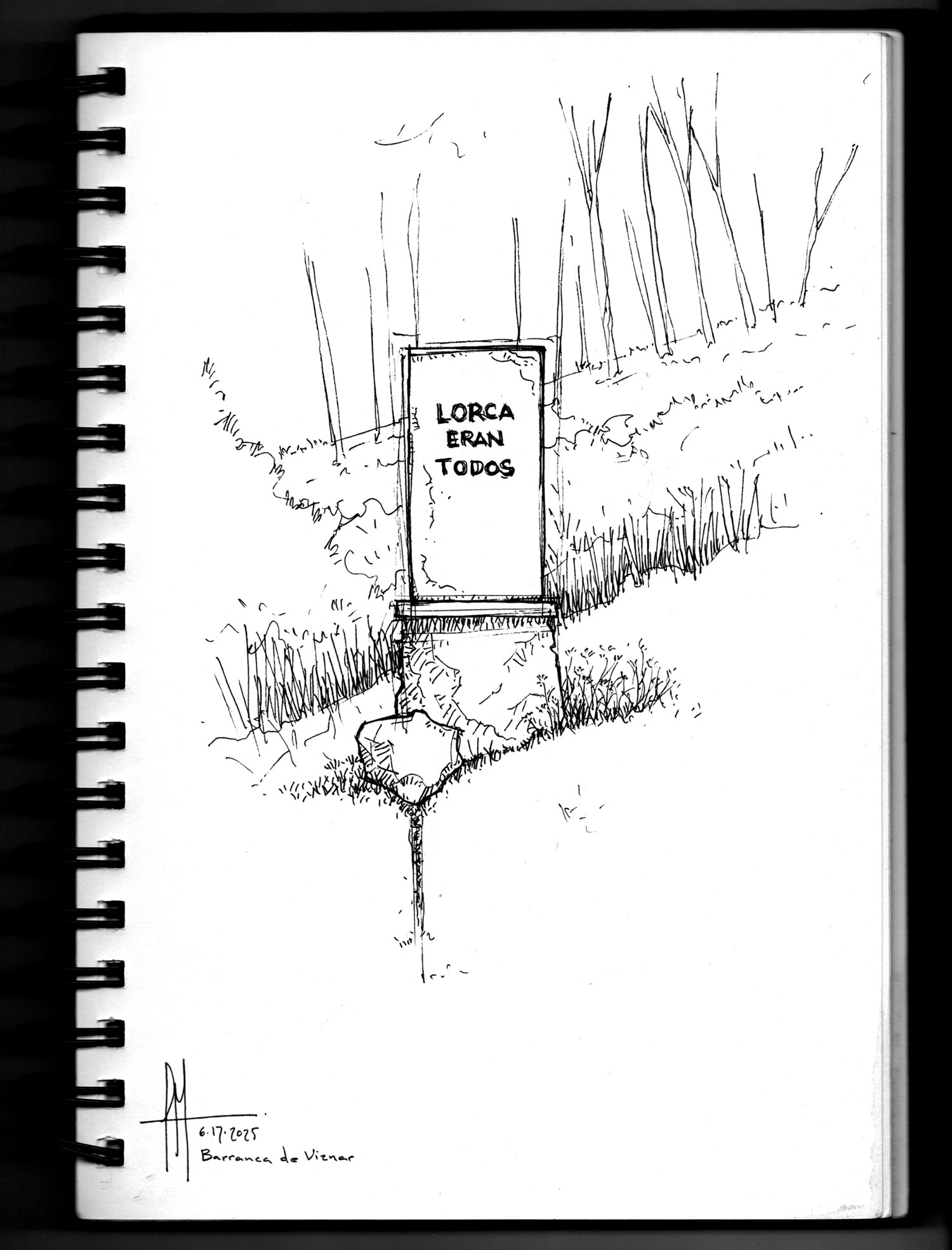
Córdoba, 6.12.2025
Though this isn’t my land, I feel like I’m going back to my past – to some childhood filled with Federico Garcia Lorca, with my mother reading to me from her Romancero Gitano under a full moon on our farm in Ecuador. I would make her read Romance Sonámbulo over and over. I got my love of poetry from my mother and Lorca, and I probably also got my dislike for cops and authority from those nights – Federico’s poems of the dreaded Guardia Civil attacking caravans of gypsies, my mother’s retelling the story of his murder by Franco’s fascists.
Córdoba is a city I could see myself living in, less touristed than Granada. We get in late in the afternoon, and Michelle and Carmelo go to bed early, but I go out for a night walk under the full moon, with lovers strolling hand-in-hand on the Roman bridge over the Guadalquivir, or sitting close in the shadows under the old city walls. Just outside of the preserved historic old town with its famous Mezquita and Jewish Quarter, is a newer city, but still a city, that is, a city built before the car took over, maybe 1900s, four and seven stories tall along narrow winding streets laid out in an even older time, with tiny lanes just wide enough for a taxi to go one way. The streets widen at times into oddly-shaped little plazas, some quiet with a single orange tree in the center or a ramada of grapes, others filled with cafe seating. Wider pedestrian malls are shaded by cloth strung across the streets six stories up. The scale and density seem “just right,” not an overbearing crowding or buildings blocking out the light, nor a rigidity of straight lines: nothing like this in the grid plans laid out after the 19th century. It’s a very public society, even now, in the time of social media and streaming movies, the cafes filled at all hours. We follow Calle Jesus y María from the old town to the 19th century extension, along a conservatory of musical, a theater school and a dance school, with students crowding the public stairs and cafes. The street ends at the Plaza de las Tendillas, where a city worker puts up Pride flags while a group gathers to protest the arrest of six organizers at a bread factory in Asturias. At the cafe, we are surrounded by smokers. We end up past the City Hall, with Palestinian flags hung from the windows, to an old cloister, a gathering place for the town punks, where local women come to feed the colony of feral cats.
It’s hard to believe the Spanish Civil War began in this city, with a military putsch to overthrow the civilian government, followed by a bloody repression that killed almost 10,000 Cordobeses during and immediately after the war. I find a bookstore across from the Roman ruins, and chat with the owner about the wave of books now unearthing the historic memory of the war, and about our Franquista relatives. Her grandfather had been a Falangist, a “blue shirt,” but when democracy came, he became a socialist. Córdoba elected the first communist mayor of a major city after Franco’s death, and the policies of “El Califa Rojo,” Jose Anguita – left unity and a program based on popular assemblies and grassroots movements – have become the core of today’s Spanish left.


Granada, 6.15.2025
Granada has a smaller overall population than Córdoba, but its old town feels busier, more tourists, more cars, and also more street art, wheat-pasted posters about rents, over-tourism, and Palestine.
If the Mezquita in Córdoba had a somberness to it, its unending columns and arches like a dark quiet forest, the Palace of the Nasrids in the Alhambra is like an ecstasy trip, fractal explosions of patterns. I feel as though I walk around with a smile constantly on my face. We wait for the night-time tour, just at the hour that the wallows swoop out. After about fifteen minutes the bats come out and the swallows disappear. And in another five minutes the bats are gone. Are they done with their feast, or have they moved on to the wider feast of the city?
The 19th and early 20th Century streets, some narrow, some wide boulevards, are flanked by eight-story buildings. While tall, few buildings are wider than 50-60’, keeping a sense of variety and scale. At what width does a building acquire that sense of anonymity or gigantism that seems to characterize most urban post-war construction, that sense that these are more than concrete, but homes for people and human activity?


On our last days in Granada, I make a pilgrimage to the place where Lorca was killed. l’ve been dreaming about this trip since the early 9Os, when I first translated poems from the Romancero for a poetry class, first imagined life in the Second Republic, in the barricades of Barcelona. Now I feel like I’m here for a more cynical reason: to see how people carried on, how they survived and resisted, under 40 years of fascist rule.
Just up from the Barranco de Viznar, where hundreds of bodies have been found, is a magical fountain of spring water, with little bubbles burbling up from the bottom of the pool. I hike along an unkempt path from the fountain to the Barranco, past the sound of goat bells, wildflowers, butterflies and bees, wild figs, and a brick-lined irrigation channel flowing with water to feed the olive trees below. It seems so peaceful. Hard to imagine the truckloads of Republicans, anarchists, communists, friends and lovers and acquaintances who just happened to be associated with a leftist, shot before the firing squads, their bodies brought here to the Barranco to be dumped. Did they make them dig their own trenches, make them bury their comrades?
At the memorial site, someone has tied a white bandana (now old, faded, dirty) from the Madres de la Plaza de Mayo, with the words “Memoria, Verdad, Justicia.” Signs along the path say “Ruta de Memoria Histórica.” Unlike other sites of massacres and genocides in other countries, in Spain there was never any justice, no accountability. But at least now, 50 years since the return to democracy, there’s an effort to remember. As though memory – public memory – is powerful enough to avoid the return of the terror and repression.
As we walk back up the hill from the Barranco, Michelle sees a group of deer on the hillside (or are they mountain goats?), stepping off a rock to drop into the little gorge below. I think of them as the spirits of the murdered, circling the last place where they were alive as humans, checking to see how it’s being cared for, remembered.
It’s so peaceful here, a hot Granada afternoon. That’s why they need the markers, the memory. One more thing about Viznar. A sign tells how the fascists planted fast-growing pine trees over the barranco to hide the atrocities. And I think of those fast-growing European pines planted by the Israeli National Fund to hide the atrocities of the Nakba, to turn villages of the disappeared into “natural areas” where they could say, “no one was here, this was a land without a people.”
We don’t make it to Lorca’s birthplace in Fuente Vaqueros, or to his family house in Granada, the Huerto de San Vicente. I was hoping to see his study, where he wrote his plays, Bernarda Alba and Bodas de Sangre. 38 years old. Now his name is everywhere in Granada, the Granada airport, the streets, the statues, everywhere, in every town in Granada, he whose name the Generalísimo tried for forty years to have erased.
At the Garcia Lorca Park near Viznar, I read: “¿Si la muerte es la muerte qué será de los poetas y de las cosas dormidas que ya nadie las recuerda? ¡Oh sol de las esperanzas! ¡Agua clariluna nueva! ¡Corazones de los niños! ¡Almas rudas de las piedras! Hoy siento en el corazon un vago temblor de estrellas y todas las rosas son tan blancas como mi pena.” (Cancion Otoñal 1.918)

Las Alpujarras, 6.16.2025
Snow still caps the highest mountains on the Sierra Nevada between Granada and the sea. We drive past the tops of windmills, at the height of the turbines, marveling at their scale. We drive up to the Barranco de Poqueira, and its three little whitewashed villages. Pampaneira, the lowest of the three, is my favorite, with open water channels flowing in the middle of narrow streets with barely room to stand, flowing with fresh spring water fed from a fountain in the middle of town. Michelle asks for tap water at the restaurant, and the owner tells us to just fill our bottles from the fountain, “la mejor agua,” she says. The highest village, Capileira, seems especially overrun by British ex-pats. The Alpujarras once had the highest poverty and illiteracy in Spain, and had been slowly emptying out in the 70s and 80s as people fled to the cities in search of jobs and to escape their past. But then the British invasion started, and the expats started to fill old houses, and a new economy developed to serve the tourists, with tapas bars and local woven goods.
We stop at Lanjarón, where we gather magical spring waters from the public fountains found at every corner and plaza. At a tapas bar in Lanjarón, where the old Brits come for dinner for under ten dollars (two glasses of wine and the accompanying free tapas), Michelle finds an English-language magazine, with ads for beach parties and conspiracy theories about chem trails and sunscreen being a hoax. Later, in Valencia, I see old wheat-pasted posters, crossed out in red paint, about vaccine conspiracies, and read about Vox, Spain’s ultra-right party, denying that climate change had anything to do with last year’s deadly DANA floods. Q-Anon is alive and well in Spain as well.
I hike from Capileira to Bubión down a lonely goat path, past waterfalls and singing birds and wild figs. Supposedly, on a clear day, you might be able to see clear to the mountains of Morocco, but today is full of haze. Either “calima,” the haze of Saharan sand and dust that often envelops this area, or the smoke particles from the Canadian wildfires now reaching to Europe, or both.
I imagine the Republican refugees from Granada hiding out in the hillsides, some 20,000, during the Civil War, Republican militias coming down from the mountains to mount guerrilla attacks on the occupying fascists. They were long, cold, hungry winters for both sides, hunkered down in their trenches. Sometimes the Republicans and the Nationalists found themselves digging the same frozen fields for unharvested potatoes, or one side or the other would send a boy from one of the villages (thinking that a child wouldn’t be shot, which is a rule that no longer exists in places like the West Bank or Gaza), to trade with the other side, tobacco from the Nationalist-held ports in exchange for cigarette paper from the Republican-controlled factories. My friend Tom writes me, telling how Juan Garcia Oliver proposed sending organizers and weapons to build up a guerrilla war from the Alpujarras, but Stalin’s Communist Party agents, always fearing loss of control, stopped it. I keep wandering what the world would have been like had the Spanish Civil War had a different outcome, if the West had not blockaded the Republic but come to its aid, had Russia not used Spain for its own purposes, what would World War II have looked like, or the Holocaust, or the years to follow, had there been a liberatory democratic vision in place, however imperfect and in progress, that we could all look to. Had it been armed.

Salobreña, 6.17.2025
We spend a couple of nights along the coast down from Granada, at a small village called Salobreña tumbling down a hillside from the old Moorish fort to a wide beach. In Salobreña, and at the top of the sendero down to the Cala del Cañuelo beach, we see murals commemorating “La Desbandé” (the disbanded, in the Andalucian dialect). As Málaga was overtaken by fascist forces (including a brigade sent by Mussolini and air support from Hitler), families of Republicans, defenders of democracy, fled down the coastal roads to Almería, with barefoot children, frail elders, families carrying what belongings they could carry. The fascists shot them down as they fled, artillery shells from destroyers off the Mediterranean coast, and bombed them from the air. Over 5,000 died in the massacre on the Málaga-Almería road. I think of the lines of Palestinians fleeing from one side of Gaza to another, at each lsraeli-declared “evacuation zone,” shot down by IDF snipers or drones or missile strikes.
I read about the old feuds (depending on source – between clans and families, or between the landless poor and the middle sectors just above them), the resentments and reprisals, but also, under it, the greed cynically mixed with a veneer of ideology, how the “reward” for turning in a neighbor was to get their house, and how the losing side – the supporters of democracy or of long-awaited justice – were left homeless, denied jobs or education, the women’s heads shaved, all marked for life. I think of the Zionist occupiers stealing Palestinian homes in Jerusalem or settlers plowing down olive groves in the West Bank, of the greed for others’ lands, of the rewards of injustice. I wonder – try to imagine – what a process of “Recovery of Historic Memory” might look like someday in a liberated Palestine, between Isrealis and Palestinians, how to account for the past and build for a future…

Almería, 6.18.2025
Along the Mediterranean coast of Spain, in Almería and Valencia and Barcelona, there are parrots everywhere, reminding me somehow of how close we are to Africa. In Almería, we arrive at siesta time, when all the restaurants are closed. The only open restaurants are a few Moroccan places along the waterfront. Sitting at a Moroccan café, with the regulars, all men, drinking beer and smoking and speaking in Arabic, with the screech of roving parrots from the banyan tree on the boulevard, I can imagine I’m in old Guayaquil, in my parents’ era, sitting along the Malecón circa 1950.
At Almería, we stay at the hotel La Perla in the old town. A news article framed in the lobby tells of the building’s history as a guest house for vacationing Granadinos in the 1920s and 30s, then closing down during the Civil War when Granada was occupied, its ground floor becoming a meeting place for the workers’ committees who governed the city during the war. Then, the article says, new owners modernized it in 1939 and turned it into a hotel. One wonders what happened to the old owners after the war…?
More streets named García Lorca. Every city has a street named for Federico. I imagine these were once streets named for El Generalísimo Francisco Franco or General Mola or the falangist Primo de Rivera. At the time of his death, Franco’s legacy was everywhere, and Lorca’s name still banned. What to do with all those symbols of fascism’s victory, Franco’s face everywhere, his names? Now the kind face of the faggot poet he hated so much smiles back everywhere, his name in every town. With what will we replace all those empty pedestals back home, that once held statues of confederate generals, “owners” of enslaved people (when will we remove Washington and Jefferson?), colonizers, conquistadores, perpetrators of genocide? What kinds of heroes to replaces them with? Or not heroes – something else? The empty pedestals seem to want something – either a reckoning or a return. And the new confederacy waits on the wings. Who is our queer genius poet to consign them to a bad memory, a foul aftertaste of a shameful past…?
In the plaza just outside the hotel La Perla is an entrance to the “refugios,” the Civil War bomb shelters. A map inscribed in metal shows the locations of the tunnels that criss-crossed Almería, connecting the plazas. I think of tunnels and air raid shelters, as Iran and Israel trade missiles, as Israel keeps killing Palestinians (every day the number is another 40, 50, 60, 70 killed), while our attention is elsewhere.

Cartagena, 6.19.2025
On the way to Valencia we stop for a night in Cartagena. I want to see the ancient Roman ruins, and the place from which Hanibal launched his attack on Rome.
Walking along the streets that surround the Teatro Romano, I find references to the old barrio de pescadores that people built over the terraces of the Roman theater, that was at one time one of the poorest sectors of the city. It wasn’t until the city began its efforts to expropriate and redevelop the working-class neighborhoods that the ruins of the Teatro were discovered, which then became the justification for mass eviction and “slum-clearance.”
It seems that the story of every city, of every land, is a story of displacements, and of resistance to displacement. And then, after the displacement is successful, or partially successful, comes the commodification of the displaced places, with tapas bars and short-term rentals and museums, for the benefit of tourists like me.
Every city in southern Spain had its Moorish Quarter and its Jewish Quarter, now tourist attractions. What happened after the Expulsion? What were the caravans and boats filled with Moors and Jews leaving for North Africa and Turkey like? How many of them became conversos (like perhaps my ancestors, “Martí” being a common surname taken by Sefardic conversos)? Who occupied those expropriated places? And how did the occupiers erase or embrace that history, make it “theirs,” while the original people, the families of the builders, were disappeared or in hiding?
I’m brought back to a video shared recently by a Palestinian woman, visiting her grandfather’s house in Jerusalem, holding up an old photograph against the backdrop of the current house, with its Israeli flag planted like any conquistador flag on the balcony, where her grandfather perhaps once cared for his roses…
Where did all the old pescadores of Cartagena go? Cartagena, I read, became a naval center for the Spanish Armada in the 17th Century, then a mining center in the late 19th and early 20th Centuries, attracting peasants from the countryside and becoming a hotbed for radical labor organizing. In the Civil War, it was the headquarters of the Republican Navy, and the last city to fall to the fascists. Unlike other cities we’ve visited, I find little of that history in public plaques — just statues to old kings, to Columbus (they love Columbus in Spain), to nuns leading Holy Week processions, to writers and teachers… The old city near the ruins is filled with empty husks of buildings, crumbling 18th Century facades held up by metal scaffolding, waiting for… what? After the war, the city languished, then had an upswing in the 60s-70s when the mining industry picked up, then faced a disastrous crash with the deindustrialization of the 90s, just as the government was starting to get on with its campaign of slum eradication and “modernization.” The workers launched a wave of strikes, and at one point burned down the regional assembly building. But on the streets, I see little sign of that history, just the empty husks of apartment buildings.

Valencia, 6.23.2025
In Valencia, my father’s land, we stay in the Cabanyal, a rough working-class neighborhood near the waterfront. I bike around the neighborhood early in the morning, observing the murals and graffiti, wheat-pasted CGT May Day posters, posters against “Turistificación.” We’re right by the beach, and tourists have started to crowd the streets in preparation for St. Joan’s Day, an all-night celebration with bonfires on every beach in Catalunya. The tension between the old neighborhood and the new is very visible on the street. But many of the old squats are still here, there’s an “Ateneo Libertario,” and a lefty bookstore/restaurant called Batisfera. Later, I bike along the Turia (the old river turned park) to the more bohemian Russafa, settle down to write at another cafe/bookstore, the Ubik (named after a Philip K. Dick story?). Beyond that is the casco antiguo, el Carmen, filled with tourists who have arrived for the Corpus Cristi celebrations. But when you move beyond the grand boulevards and plazas of the center, the old town still has its okupas, its squats from the 80s and 90s, with murals of resistance and tenant association banners. My cousin Kike tells us it was much wilder in the 90s, but if not for the squats, he says, many of these old buildings would have been just left to rot or demolished.
I finally meet my cousins, Carmen, Montserrat, and Kike, whom I’ve never met in person. They invite us to homemade Valencian paella at their home outside of Valencia very close to last year’s deadly Dana floods. They live together on the same property with three houses, all three siblings, and, until he passed two months ago, their father. The house is on the outskirts of Torrent, in an area that was once all farmland and orange orchards (like the area where my aunt’s house was in San Gabriel, once orange orchards paved over for suburbs). There, among the orchards, their father built a weekend “chalet,” and over time, the family moved in permanently, the three kids in one bedroom. The original house was built on stilts, and over time the ground floor got filled in for a kitchen and sala, and then Carmen built her own house, and finally Montse. The father lived in that house till he died, cared for by Carmen and Montse.
They share stories of our grandmother, Yaya Pepa, how she was so “modern” and “peculiar,” how she had “un carácter tremendo,” fought with everyone. It seems like Yaya did not get along with her parents, or her siblings. There were seven of them. She grew up in Cervera, where the name “Tarruell” originated. Her father Federico owned a mill or factory in Cervera, but apparently he lost all his money. At some point, they moved to Barcelona looking for opportunities (I find a reference to Yaya’s brother, the priest, going to primary school in Barcelona).
During the Civil War, my dad’s grandmother and uncle and aunt all emigrated to Ecuador. I knew Tío Cayetano’s story: that he was training to be a Salesian priest, that he left with bullet fragments in his head when the Salesians were attacked by anti-clerical Republicans. But I learn something new about Tía Lola: that she may have had a child out of wedlock, that she had given her up for adoption before leaving for Ecuador to start a new life. They are all buried in Ecuador now.
La Yaya Pepa stayed in Spain with her family. She was difficult, but also smart, spoke French as well as Catalán and Castellano, worked at the international switchboard of the Telefónica, her husband Juan was a lineman for the Telefónica, always on the road. I still don’t know anything about their politics, though I know the Telefónica was a hotbed of CNT organizing, and I can’t imagine Yaya Pepa’s character as conservative. My cousins’ mother, Carmen, always called her Pepa, not mamá. When Carmen left grandma in charge of the kids, Yaya Pepa would let them leave the house on their own, whispering, “don’t tell your parents.”
Yayo Juan – Juan Martí Gabaldá – was the opposite of her in character, always serious. He was tall, always well-dressed. He was a driver or a lineman for the Telefónica, always on the road. I remember my dad saying he was not around much. They fought a lot, perhaps that’s why he was always on the road.
They had two kids. Carmen, the older, was born in Manresa; my dad, Juan, in Granollers, an hour from Barcelona. The Telefónica gave them opportunities to move. I had thought they moved to Valencia to escape the fighting in Barcelona, but Pepa, apparently had another story: that he had a “querida” in Valencia. Or perhaps, like many at the time, they wanted to move to a place where they were not known.
I read about the “vaciamiento,” the emptying out of the countryside in the 1940s and 50s as people left for the big cities in search of jobs. Or they were fleeing from their own histories, the people and the Guardias Civiles who may have known of their associations in the villages and smaller cities. I think of Yayo Juan and Pepa, moving from Barcelona to Manresa to Granollers and finally to a whole other province, to Valencia, and I think of Lola leaving Spain altogether.
Juan and Pepa settled just outside the old quarter of Valencia, a block away from the Turia, on Dr. Zamenhof Street, named after the inventor of Esperanto. I remember my dad’s little Esperanto dictionary. I wonder about the name of this street: Esperanto was denounced by Hitler as a Jewish conspiracy, banned by Stalin and Franco and Imperial Japan. I bike to Dr. Zamenhof Street, three blocks long, with 1940s working class apartments, big six-story blocks. At one end of the street, I pass an open doorway, tenants sitting on the stairs, clearly meeting with a tenant organizer. I want to listen in. There are still a few empty lots on the street, and I wonder if one of these is where my father had his childhood accident. The story is fuzzy now: either he fell while playing in a bombed-out building, or some unexploded ordinance blew up near him, but what I remember is how he would aways show off the enormous scar across his belly. He spent many months in a hospital recovering from his wounds. I have a photo of him from that time, with his shirt tucked into his shorts, looking skeletally skinny.
My dad and his sister were born in the Republic, right at the start of the Civil War. But all my dad’s living memories were under Franco, his thinking shaped under fascism. ls the silence of stories a silence of that time?
My dad’s older sister Carmen was sent to a colegio de monjas, an internado (a weekday room and board). I don’t know where my dad went to school. Carmen always thought he was Yaya’s favorite, and I remember hearing my mom saying he was a mama’s boy.
What my cousins know of my dad was that he was an experimentador. He served his mandatory time in the mili, then learned to become a tailor, tried to start a business out of their tiny apartment. I had never heard this story. He didn’t have much success, and there weren’t many jobs in Valencia, so he left for Ecuador where his Tío Cayetano and Tía Lola already lived. I love that the cousins recognized my dad as an experimentador. I remember him fixing every engine and electronic appliance on the farm, learning veterinary science by correspondence course, and, much later, holed up in his bedroom working on drawings for what looked like a perpetual motion machine…
Yayo Juan died in his 60s, of a heart attack, maybe 1965. After he died, Yaya Pepa refused to wear black like all the other widows; she carried on wearing makeup and colorful dresses. When she moved in with her daughter in Torrent, she stood out in the small town as a big city oddity from Barcelona. Yaya Pepa died in 1990 – at 90, born with the century.
The story I remember of how my parents met was that her priest in Ecuador, Tío Cayetano, told her of his family in Spain that she should meet when she traveled there in the early 60s. I wonder from what port my mother embarked on her return to Ecuador? Digging on the internet, it seems most ships left from the port of Barcelona. My cousins also remember hearing my dad’s version: that they met in the port in Barcelona, getting on a ship to Ecuador, and that it was like the Titanic, my dad with the poor people down in the lower decks, my mom on the upper decks in first class. He was Leonardo DiCaprio, but there was no iceberg. Or maybe that came later after they married. The trip would have taken a month, leaving from Barcelona, stopping in Venezuela, crossing the Panama Canal to arrive in Guayaquil: time enough for a good romance.
In 1970, after her husband had died, Yaya Pepa made that trip too, to visit her son’s family in Ecuador. The only memory I have related to her is from that visit when I was three: the shock of seeing her dentures in a glass in the bathroom. She had fought with her daughter Carmen in Spain, now very pregnant, had left for Ecuador to see her son, and when she got to Ecuador, only stayed for a few days. She either fought with my dad or with my mom or both, or my parents were fighting and she couldn’t stand it, and she turned around and left for Spain again. If she traveled by ship, she must have been away for two to three months, and she missed her grandson’s Kike’s birth.
Between Barcelona and Valencia, I think I prefer Valencia. It still seems to have that fight, that bohemian messiness, still close to the city center, where the old, pre-car bohemian city is still in play, its future not yet entirely defined by tourism, commerce, and real estate. But I’m an outsider, looking in for a few short days. In Kike’s eyes, el Carmen is now a gentrified neighborhood, the bars, the punkies (as he calls them), the okupas of his youth mostly gone or transformed. Walking beyond the crooked streets of murals and the okupas, you leave the Casco Antiguo, to an orthogonal grid of 1940s-era apartments blocks, and the street where my dad grew up, Dr. Zamenhof Street. No tourists here but me, just a working class and immigrant neighborhood, tenant association banners hanging from balconies.
A few days later we read of a scandal in Murcia, the next province over, internet chat boards calling for death to the Moros, meaning north African immigrants, as though the Inquisition and the Expulsion of 1492 had never ended.
Leaving the train station, we see a building with a CGT billboard over it. The CGT seems big in Valencia, the main inheritor today of Spain’s anarcho-syndicalist dreams (the CNT having been reconstituted in the 1970s, then systematically destroyed with Cointelpro-style interventions by the police). I wonder now, 90 years since the social revolution that exploded in Spain in 1936, what is left as possible? The social revolution did not appear out of nowhere, out of a simple explosion of resistance and rage against the church and the landowners, but out of 40 years of the building up of a working-class liberatory political culture, from the 1890s to the 1930s. Franco and the church (which ran every school in Spain for 40 years under the fascist dictatorship) did their best to beat that political culture out of several generations, that sense of revolutionary potential, until the powers in the 1970s felt that Spanish society was again “safe for democracy.”

Barcelona – Gaudí, 6.26.2025
In Barcelona we stay in a hostel in the heart of the old city. The Barrio Gotic, the medieval town, is filled with tourists, but also with old school bars and antiquarian bookshops tucked away in tiny storefronts. El Born, closer to the waterfront, probably has the most visible gentrification, old working-class buildings, anarchist flyers, next to those bespoke little storefront galleries of the young professional upscalers. In the hinge between the Barrio Gotic and Born we find a little solidarity restaurant run by youth, next to a community garden. A mosaic sign memorializes that this space was saved through community struggle to create a self-managed garden and playground – there are still people’s spaces carved out of the turistification and gentrification.
From our hostel, I walk past Gaudí’s Casa Batlló and La Pedrera (Casa Miló) every day. I spend some time painting watercolors of Gaudi’s houses, and sketching the Art Nouveau street lights of the Paseo de Gracia (by Pere Falqués i Urpí, 1906). Gaudí’s Modernisme was a certain vision of modernity that then passed us by. It took the hand-worked crafts of the past and brought them into a possible future, very much about traditional Catalan culture but also about something new. It seems like an unrepeatable moment, when craft was still so present, but new technologies and the confrontation with mechanization was in full swing. These works were not Gaudí’s as much of a gathering of craftsmen led by Gaudí’s vision, bringing their own individual contributions to the whole. But these were also not a participatory people’s vernacular. These works were only possible – like most of so-called “architecture” everywhere – by the funding of Capital or the State. In this case, by the sponsorship of the wealthy bourgeoisie of Barcelona (many, it’s coming out now, heirs to wealth of colonizers and enslavers), or by the powerful Spanish church (which in Spain, was very much part of the State). I doubt we can see something like this again.
Calatrava’s City of Arts and Science in Valencia may be the heir of Gaudí, in terms of a biological or crystalline structure like Gaudí’s, but on a grand mechanical scale, subsuming the human in its gigantism. In Barcelona’s Montjuic we find the complete opposite of Gaudí’s organic approach to modernism: the sterile lines of Mies Van Der Rohe’s 1929 Barcelona Pavilion. It is beautiful, like a jewel, with barely any appearance of the human body. Or, rather, a clean, undecorated backdrop, a void to contrast with the messiness human activity. If the gigantism of Calatrava’s architecture leaves the human feeling tiny, inconsequential to the global forces plowing us toward the future of Imperial Coruscant (our taxi driver in Valencia tells how the entire Calatrava city was closed for four months for the filming of Andor season 2), Mies’ pavilion leaves the human feeling inadequate, dirty or imperfect, within its crisp clean geometry. On my last day in Barcelona, I stumble onto the Mercat Santa Caterina, an old public market with a new undulating tiled roof by Enric Miralles and Benedetta Tagliabue– maybe my favorite contemporary work from the trip, combining the organic structure of Calatrava with something much more intimate, the daily practice of finding produce for the dinner table.
But Gaudí’s Casa Batllo leaves me with something else. There’s a scale to this apartment building, and the buildings along all these avenues, that feels particularly comfortable, 40’ or 50’ wide, six stories high, so unlike the big “blocks” of “units” that pass as urban multifamily housing today. There’s a tall storefront and a lobby that reaches back to the courtyard, a blue-tiled stair/lightwell that feels like climbing up through the sea toward the sky. The wealthy owners, the Batllos, lived on the second floor, where the stained-glass living room windows could be lifted up to turn the whole space into an open balcony overlooking the street. Above it were four more floors of rental apartments, four on each floor, each with a unique handmade symbol for its door, above that a magical whale-ribbed attic where the servants worked, topped by a roof deck with mosaic dragon-shaped roofs and chimneys. Now the entire thing is a museum, but I can imagine a building much like this, the second floor turned into a grand common space looking out over the street, serving the apartments above, all of us enjoying the privileges of the wealthy.


Barcelona – Guerra Civil, 6.27.2025
We take a four-hour walking tour of Civil War Barcelona with historian Nick Lloyd. Barcelona was the biggest industrial metropolis in Spain, filled with both extreme wealth (those industrialist benefactors of Gaudí houses and parks), and extreme poverty. It was also the inheritor of decades of anarchist political culture. If you were an anarchist, Nick says, chances are grandma was an anarchist too: it ran in your blood. When the military revolted against the Republic, and the independent Catalan bourgeoisie found itself in disarray, the workers were already steeped in a political culture that not only taught resistance, but the idea that they could run things themselves, without military, church, state, or capitalists.
There was something else unique about Barcelona: the lack of legitimacy of any of the traditional “institutions” of order. Until the Republic, Spain’s government had served primarily as an extension of the aristocracy, providing little of the minimum infrastructure and services that defined the modern bourgeoise state. One of the biggest accomplishments of the young Republic was to initiate the construction of 16,000 public schools. The Catholic church too, was seen simply as tool of oppression, with only 20% of Spaniards regularly attending church, and a great deal of hatred for the priests. Vengeance for years of oppression was swift – in the first days of the Civil War almost every church in Barcelona was sacked or destroyed, and hundreds of priests were killed throughout Spain (though this was not unique to the Republic, a similar anticlerical uprising had happened in 1905). Which is why my dad’s uncle, training for the priesthood, fled for Ecuador with bullet fragments in his skull.
Nick shows us ephemera from those days: railway passes and tickets to the latest Hollywood movies printed by the CNT, revolutionary children’s books, a postcard of the Telefónica. Everything became collectivized – not “nationalized” – by the workers’ committees. All along our trip we see memorials to “sites of historic memory:” the atrocities, the executions, the bombings, the mass graves. It is a relatively recent thing, Spain having waited 40 more years after the death of Franco, after the rest of the perpetrators were dead, to begin to remember. But despite these memorials to the atrocities, we find little to commemorate the liberatory spirit, that moment when history returned to the workers.
In the aftermath of the war, Franco turned over all those schools initiated by the Republic to the Catholic church, basically obligating church education throughout Spain for 40 years, generations of mandatory Catholic indoctrination – my father’s generation. What’s surprising is how little it stuck, how quickly the generation of the transición threw off the shackles of Franco’s “National-Catholicism.”
I wonder about this story of the groundwork for a social revolution in contrast to our own USian times of “constitutional crisis,” extreme austerity, and naked authoritarianism. In Spain there was a convergence of conditions – a state and institutions that had ceased to provide either legitimacy or material benefits to large sections of the peoples, and a people with a generational political culture that prepared them to take power for themselves…
The days from July 1936 to May 1937 in Barcelona are perhaps the closest we have to a modern social revolutionary process (as opposed to the political revolutions that took state power and then had to become the new managers of the state). Chiapas or Rojava are contemporary analogues, but these are far from the economic and global centers that Barcelona represented.
One wonders if the fall of Barcelona was inevitable. The capitalists allow democracy as long as it stays close to the political center, swinging from slightly more liberal and then back to more conservative, every four to twelve years, rarely straying too far from the center. There are only two options: stay in the center, or veer toward fascism, Capital’s “corrective” for when too much democracy begins to take hold. Then, after 20 or 40 years of despotism, they can hand the reigns back over to “democracy” as long as the people stay to the center, afraid of a return to the horrors. If a majority of those who vote do not care about politics (“what’s it matter, they’re all corrupt”), or they hold their head down in fear (“don’t get involved”), or see it as a joke (“vote for the buffoon, at least it’ll be fun to watch”), what is there for those of us who believe in a better world, in justice and equality?
Did the modest social democratic aspirations of the Republic (Schooling for everyone! A people’s theater! Votes for women!) make the turn to fascism inevitable? Did the possibility of Bernie Sanders, of socialists winning once again in our cities, make Trump inevitable? Does the world that Trump’s enablers envision – extreme austerity, eviscerated state, no health care, no education department – again create the conditions for change to the left? They know the only way their austerity vision survives, without an eventual blowback from the people, is through ever-greater control of democratic systems (voter suppression, gerrymandering, control of the courts), and the growth of an internal repressive apparatus (our new Gestapo ICE). That’s what we’ll be going back to in a week when our trip is over.

Granollers, 6.28.2025
Leaving Barcelona, we drive to Granollers, the city where my father was born in August 1936, a month into the military insurrection.
I have no idea where exactly his family lived, but I find the entrance to the main refugio, the bomb shelter, just off the main square. Every city in Spain seems to have a bomb shelter, a reminder of the horrors of the Civil War. This one is marked by a little sign of Memoria Histórica, but it does show up on Google maps.
Granollers suffered one of the worst aerial bombings of the Civil War, carried out by Italian bombers in September 1938. My dad would have been two years old, his sister maybe seven. I wonder how they experienced that day. There were no military targets in Granollers, except a train station. It was city known for its agriculture and textile industry. There were few resources for the shelters, so most people sheltered in the basements of factories and churches. And the shelters that did get built had no toilets, no food storage, no medicines, no places to sit. I wonder how many times the family went into those dank tunnels. Were they there that day? The bombing happened a little after 9AM, when school was in session, on a market day. Or, after the bombs fell, what did they do among the debris, and the injured and the dead? 224 people were killed that day, another 700 injured.

Llançá, 6.29.2025
We stay with friends in Llançá. It is a quiet little town, filled with French tourists in the summer and empty in winter, with a marina and beaches, and an old town up in the hills. It has a plaza that I fall in love with right away, with all the elements of a good plaza.
There’s an enormous tree that shades half the plaza, “El Árbol de la Libertad,” planted in 1870, with a stone plinth at its base where people sit. At the center of the plaza is a square stone tower, originally part of a church, but when the church was rebuilt to one edge of the plaza, the tower was left as the town’s campanile. On one corner is the town fountain, with four water sources, one on each side, and an old well crank like you see in the movies. There’s a café/bar/restaurant with chairs and tables filling half the plaza, shaded by the giant tree of liberty or a smaller magnolia on the other side of the tower. On one side is a modern cultural center/theater, and on another the “new” church, built in the 1800s. A small door under the church marks the entrance to the town’s bomb shelter.
This little town of Llançá was along one of the most important routes for refugees from fascist Spain, following the railway lines to Portbou on the border with France. It was a constant target for fascist bombers. A couple of blocks from the plaza is an old holiday mansion with a huge yard. In the opening of the Civil War in 1936, the CNT-FAI took it over, and in 1937 started an anarchist school for some 200-300 children of Republican refugees, many orphans, la Colonia Ascaso-Durruti. After the Civil War, the school was taken over by the Women’s Section of the Falange, who ran it as a camp for falangist girls. I imagine this building, now used for occasional cultural events by the town council, once bustling with refugee kids, and wonder what their anarchist lesson plans would have looked like.

Portbou, 7.1.2025
In Portbou at the French border crossing, we make a pilgrimage to the Walter Benjamin memorial. We come around a curve in the road, and the Mediterranean opens up before us, Africa beyond the horizon, and the Levant beyond that. I think of the Mediterranean seen from Gaza, and of the Rafah crossing.
Portbou was the last Spanish city many refugees saw in the final days of the Civil War in 1939, before crossing over to France on their way to exile, and, for many, death. Many ended up in refugee camps, which the French were already calling “concentration camps.” After Hitler invaded France, many were sent to the death camps, especially Mauthausen. The leaders in exile of the Spanish Republic were sent back to Franco’s Spain, to face execution.
In 1941, the exodus was in reverse: Jews and leftists fleeing the Nazi occupation or the complicity of the Vichy government. Walter Benjamin was among them, with a safe travel pass from the French government to allow him passage through Spain to exile in America. He arrived in Portbou after crossing the Pyrenees by foot, desperate. At the Portbou crossing, Franco’s police told him he would be handed over to the Gestapo the next day.
To get so far, for this? I think of Walter Benjamin, that collector of books, that dreamer of collective dreaming and of the Kabbalah, walker of Paris arcades, seeking new modes of liberation. To end here, accompanied by his little Paul Klee drawing of the Angelus Novus, unable to escape the angel of history. Just him and the morphine he took that night into oblivion.
The memorial is a tunnel made of thick corten steel, just the size to fit one human, buried into the hillside next to the cemetery where he was eventually thrown into the common grave, anonymous, a dark stairway through the tunnel leading down to the precipice of the Mediterranean. Just you and the sea at the end of that tunnel, the steps going on into oblivion, stopped only by a thick pane of glass. The Mediterranean waters linking me here, in this memorial to desperation and inescapability, to Gaza on the other side of the sea, a horrifying angel of history standing between hope or future, of the deception of humanity, of the need to carry morphine with you, of all the Gestapos we humans create – internal and external – inescapable. I sit there, at the and of that tunnel, finding it hard to leave.
But while Benjamin faced his Angel, some of the Republican Spaniards who escaped the fate of the camps ended up forming a backbone of the French resistance, and the Internationals who had fought for Spain became partisan leaders in each of their respective countries, in Poland and Italy and France. When the Allied troop finally arrived at Mauthausen, after the Nazi prison-guards and torturers had already fled were greeted by a banner hanging over the gates: “Los Españoles Anti-Fascistas Saludan a las Fuerzas Liberadoras.” And in the Liberation of Paris in August 1944, it was La Nueve, a company of former Spanish Republicans fighting for the French Resistance, who were the first to enter Paris.

Carcasonne and Saint-Girons, France, 7.2.2025
We want to see the Pyrenees. I don’t know what exactly to expect, but in that dream geography where my dreams always to, the Pyrenees are stony cliffs where I’m trying to escape something. The air is cooler here, and there’s more green, trees everywhere, much more than we’ve seen since we arrived in the south of Spain. We cross the border through La Jonquera, where thousands of Republican refugees passed through into exile in 1939. There’s an intense Museum of Exile in town, and not much else: just malls and supermarkets filled with French who cross the border for cheaper Spanish prices.
We stay the night in Carcasonne, in a cheap room with no air conditioning. In the morning, I wander up the hill to the castle, and along the old medieval streets within its walls. These fortifications, scattered on hilltops across the landscape throughout Europe, took such enormous effort, tons of materials and labor, and now we’re left with these Harry Potter sets. Today we build billion-dollar bunker busters, and what will we leave the future? The heat is still stifling in the morning, but in a little cafe inside the castle walls, here on top of the hill, a breeze keeps us cool.
We drive into the foothills, stopping in Saint-Girons, a beautiful mountain village with a river running through it, buildings built right up to the water like they do all through Europe. We get coffee at the café Pour Ceux, right at the old bridge. An old French hippy sitting with his dog on the café terrace overlooking the river tells us it’s the best bar in the world. The walls inside are covered with political posters and Palestine solidarity stickers. Here the posters are less about tourist gentrification and more about environmental damage to the Pyrenees, against quarries and pollution, and solidarity between Occitánia and Euskal Héria (Basque Country). As we leave, a group of older men with grizzled white beards come in, regulars. I imagine them as veterans of the barricades of ’68, retired to Saint-Girons.

Pou, France, 7.3.2025
We spend the night in Pou, in the Pyrenees-Atlantique. Even here, in France, l find reminders of the Spanish Civil War. There’s a heroic statue on the boulevard facing the Pyrenees, to the French dead of the world wars and the French colonial wars (Algiers, Morocco, Indochine), and on the plinth, a plaque has been added, to the Spanish who gave their lives in the resistance.
Cutting through the middle of the old town is an old stream bed, sunken deep beneath the level of the other streets. It was once the city’s source of fresh water, but over time small industries sprung up along its banks, polluting the waters. Eventually the stream was covered over, and the Hédas became a lively working-class community, existing several stories below the city. It became a destination for families of refugees fleeing the Spanish Civil War, its own little world within the city. I walk its length in the early morning, a quiet world now, cool, with ivy growing on the high stone walls, some abandoned buildings. At one end, a street sign announces, “Rue des Républicains Espagnols en Béarn.” There’s a community garden, and the gardener tells us this was a parking lot until just before COVID, now a quiet place of respite within the city. I ask her about the hand-painted “hedgehog crossing” signs along the road, and she tells us there are three hedgehogs who hang out in the garden by day and come out at hight. The danger, she says, is the tourist drivers getting lost in the sunken Hédas.

Aia, Basque Country, 7.4.2025
We spend two nights in Aia, a tiny town in the hills above San Sebastian. We arrive around 8PM, with cowbells sounding from the fields below giving it a magical feel. There are at least four or five tavernas in the little town of 1600 people, and at the end of the day large clumps of neighbors gather at the outdoor tables of the plaza drinking Basque cider. We practice the proper way of serving cider (sagardon), lifting the bottle high as you pour so the drink fizzes in the glass. In the plaza, kids kick a soccer ball; later, when one kid is left by himself, Carmelo and Glade join them. A group of teenagers hangs out under the shade of the church. It’s cool, but tropical, like an Ecuadorian highland forest, but with medieval stone buildings and cobbled streets and moss-covered rock stairways. I remember reading somewhere that somewhere around 1600 is the number of people we can recognize by face, an ideal size for human scale community.
There are vegetable gardens in every odd nook between the stone buildings, a feeling that people live close to their source of food. A little after dawn, I watch an older couple tending a garden above the road, collecting flowers. Later, I see the man rolling a wheelbarrow full of flowers to the old church. There’s a lot of corn growing, and beans and peppers and squash, and suddenly I realize it’s all planted as native American three sisters planting, each crop protecting and growing over the other. There are blackberry bushes along the road, enormous fig trees, a long trellis along the sidewalk with kiwis hanging low, apple trees scattered about, and a giant black walnut tree that drops walnuts over the hammocks. I hear chickens in backyards, see sheep spread out across the valley below (tinking their cowbells), a donkey, a black pony. The lands of Aia were historically owned by the municipality, and rented out to farmers, part of the Basque commons system. I wonder if it’s still that way, public land in public hands, or has it all been enclosed and privatized?
Another plaza in Aia overlooking the valley has a floor mural, a life-size board game recounting the history of the town going back to neolithic times. One of the more recent squares tells the story of the town mayor, elected in 1936 during the Second Republic, executed in 1939 when Franco’s army entered the town. Even here, in these small villages.
Below Aia is a lush valley with flowing rivers. We pass a water-powered stone mill, still in operation just 50 years ago making the town’s flour, and a water-powered iron smelting forge from 1400, where a guide brings out red hot iron rods to place under the forge’s hammers. There were over 40 of these water-powered mills and forges around the town, at a time when all energy was “renewable,” and industry, workshops, agriculture and town life more intimately connected – and in a place like this, one can imagine how that way of life is not so far away.


Donostia / San Sebastián, 7.6.2025
There are Palestinian flags hanging from one balcony or another in every place we visit in Spain, but Donostia has Palestinian flags everywhere, on every street. Colonized peoples recognize the aspirations of other colonized peoples.
We stay across the river from San Sebastián’s old town, in Gros. The view from the bridge is magical, a line of tall baroque buildings along the riverfront with the ocean opening up beyond. But behind the Hotel Maria Cristina, we find a plaza still pocked with bullet holes from the Guerra Civil. When the San Sebastián military garrison rose up in support of Franco’s insurrection, local Republicans overcame them after several days of fighting. But two months later, Franco’s forces retook the city. Half the population fled, 40,000 people. In the days that followed, over 400 Republican supporters were shot in fascist reprisals. In front of the city hall, silhouetted against the brilliance of La Concha beach, is a steel outline of the city, with 400 tiny holes.

Back to Barcelona, 7.8.2025
Part of my intention for this trip to Spain was not just to see where my father was from, but to consider how a country existed and resisted under 40 years of fascism, and how it reckoned with its past. I did not expect it to become a tour of the Spanish Civil War, but that’s a bit of what it became: starting at the ravine where Garcia Lorca was executed, to the occupation of Granada at the beginning of the war (once Franco got Mussolini’s help to ferry troops across the Mediterranean), following the Desbandá of refugees to the Alpujarras and along the coast to Almería shot at by Italian warplanes, to Valencia where my father grew up under Franco, to my grandparent’s Barcelona of heroic anarchist dreams, to the border towns of Llancá and Portbou and Jonqueres teeming with Exiliados, and finally into France, where many of the same died in Hitler’s camps or carried on their lost cause as guerrillas in the Pyrenees. All along, images of Gaza follow us: refugees fleeing from one town to the next shot at from the air, the crowds at the border crossing at Rafah, tunnels in every city as the only protection from fascist bombardment…
On my last morning in Barcelona, I sketch the old Telefónica building at the corner of the Plaça Catalunya, now with a Movistar store on the ground floor. In the heady days of the Republic, the Telefónica was the hotbed of anarcho-syndicalist organizing, and when war broke out, the anarchists effectively took control of all communications in and out of the city. I wonder if my grandmother worked here as a young woman, if perhaps that was where she developed her free-spirited and unorthodox ways. Both she and her husband worked for the Telefónica, she as a switchboard operator, he as a lineman. My cousins tell me she spoke French and worked for the international switchboards. Our Civil War tour guide says that if she was on the international switchboard, this is the building she would have worked at. But my father was born two months after the outbreak of the war, in Granollers, an hour outside of Barcelona, so they probably would no longer have been in Barcelona at the start of the social revolution in 1936.
The Spanish Civil War was the first modern war where more civilians were killed than combatants. It was the opener for the horrors to come of World War II: for Hiroshima, Nagasaki, Dresden, Stalingrad, concentration camps and death chambers. In the Plaza Sant Felip Neri we stand in front of a medieval church, its walls pockmarked by flak. While children sheltered here, it was bombed by Italian warplanes. As rescuers pulled the bodies and survivors out, the bombardment resumed, killing the rescuers. “Sites of historic memory” become today’s news. After the war, the fascists left the damage, creating a story that this was where the Republicans shot priests. The architect in charge of rebuilding the plaza subversively talked about the “revenge of memory:” knowing that history would reclaim itself someday, for truth, if not for justice. And I think again of what the “sites of historic memory” will be, 80 years from now, across the lands of Palestine.
I’m sitting in a cafe in Barcelona on July 8th, thinking of the past, drinking my cafe con leche. I pull up the daily numbers from “Tech for Palestine.” While we vacation, the news from Gaza continues relentless:
July 1: 116 killed
July 2: 365 killed
July 3: 118 killed
July 4: 138 killed
July 5: 70 killed
July 6: 80 killed
It’s a busy street a block over from the Telefónica, early morning, my last day here. Probably 100 people easily walk by while I sit. I imagine us all on a Gaza street, another cafe in Gaza, another school building in Gaza, another hospital in Gaza, another apartment block in Gaza.
When the old is beginning to fall apart, to lose its last vestiges of legitimacy, how are we to “build the new within the shell of the old,” when the fascist shock-troops are waiting to mobilize, when surveillance becomes so complete, when genocide is commonplace? Where are we left, without that generational preparation of revolutionary culture that Barcelona knew? How do we escape, and build, while still being present, connected, relevant?
On my last day in Barcelona, before returning to the States, this is what is on my mind.


